
Move fast, Rebuild things
I personally believe in systems of self-governance, where a society of workers are independent forces that align subconsciously or consciously towards an institution’s OKRs without force. Intelligence gathering in a decentralized manner, pushing information down stream into proper leadership channels, should autonomously instill action and accountability. The Agile/SCRUM system is a tad flawed, meetings for alignment should be last resort, stand-ups for alignment should be last resort. If meetings, post-intelligence spread, need to be scheduled there is a problem in the machine, but 2-week sprints of broken down problems based on intelligence is ideal. If we were to look at the machine as an upside-down pyramid, intelligence being the broadest at the highest level, reaching minute specifics towards the base. A cycle of constant alignment and execution. With a focus on 1:1’s and interpersonal professional relationships, building bonds that aid in optimal employment effectiveness.
A company or institution that calibrates this system with the right foundation could potentially be formidable force in any sector with any product. A dark factory for constant innovation. As fiscal benefits are met, benefits are proper, and company morale is always at 90% or higher, there will always be a place on the chess board. In an age where Social Media has intersected with politics impacting corporate culture, company morale is going to be a primary responsibility. Where morale and inspiration is derived from a company mission, their contributions to society, and the ability to make the workers feel seen daily. A committed leadership team will make these 3 core pillars a responsibility subconsciously while maintaining clarity about external affairs to prevent misalignment and anxiety.
This gives me a basic map on what a normal trajectory for a start-up can look like during a return of industrialist thought, especially prior to becoming a public benefit corporation. When information and intelligence channels transitions from bottom-up to top-down again. Information is power and knowledge is king, not people. Thus, building a system that can maintain information symmetry, constantly, throughout an organization is an optimal use case of large language pattern matching machines. Preventing unequal systems to exist, where roles holding power, via extraction, can evolve safely towards a professional environment that promises financial security and career stability.
After releasing their “Handbook for New Employees” Valve Corporation showed their internal operational structure. A true flat hierarchy not really seen before in corporate, especially to the extent seen at Valve. A culture of “Frankenstein” prototypes to gather data and iterate quickly. Where each member were always treated as potentials who can take over the company at any time, where each employee was competent enough to be dangerous, yet constantly learning new things. Studying the software to hardware journey, their cabal like system, and freedom for employees to move between projects eventually resulting in a multi-billion dollar corporation with under 400 employees is a testament to this importance in curating self-directed personalities.
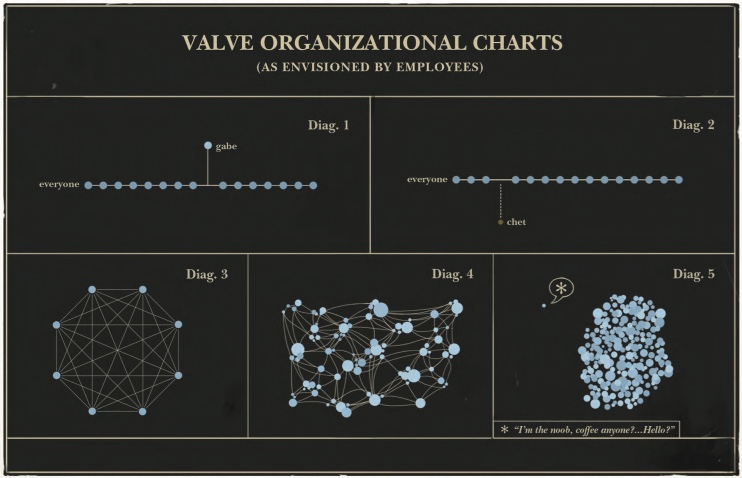
"This is because, as you’ve found out by now, you were not hired to fill a specific job description. You were hired to constantly be looking around for the most valuable work you could be doing. At the end of a project, you may end up well outside what you thought was your core area of expertise."
Harvard’s Business School reviewed Gaben’s leadership style in a research document titled: “Opening the Valve: From Software to Hardware.” Following the Industrial Revolution, towards the emergence of the modern magnificent 7 tech companies, hierarchal dichotomies was an inherited legacy model. Valve, provided a look into a future that breaks these barriers down. But, I see the industry entering another Industrial Renaissance, so I want to look at a traditional Motor Company, such as Ford, their innovations during the Great Recession and what a world would look like if merged with Valve’s self-directed cabal approach.
Bear with me on this next statement, I want this outlook to only pertain to corporate contexts and not outside the walls of an office setting. A system that views employees as machines/cars on an assembly line in their career. They are units to be assembled to reach a certain level of horsepower within their desired T-shaped specialization.
A T-shaped archetype is essentially a generalist with depth in a particular specialization.
At Ford, and alike, people and tools are required to assemble the cars, but within this context what if we retrofit the purpose of A.I. solutions to be nodes of a inter-connected learning framework that assembles the corporate gears (employees) for the machine to remain consistent and effective on the race track.
In this reality, machines help build the human promising financial and job security. Something we have failed to do for the incoming working class. Machines build the humans, guaranteeing an effective workforce, monitors the culture, while the humans produce “the cars”. An orchestra that plays perfect symphonies day and night “Until We Bleed”, metaphorically of course.
Ford’s turnaround during Bill Ford’s tenure and Alan Mulally’s entrance is a great ode to the current ego-driven corporate culture in the Silicon Valley. The observed issues and the ambitious transformation that incorporated accountability within Seniors in the corporate ranks showed this trickle-down mechanic I want to witness when combined with Valve’s extreme flat structure.
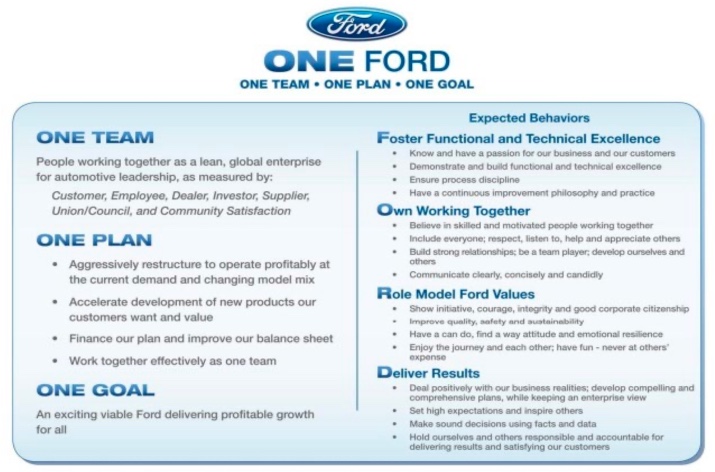
A 1925 Ford advertisement titled, “Opening the Highways for all Mankind” empowered Mulally’s vision of “people working together as a lean global enterprise for automative leadership.” Asian competitors were in the lead, rightfully so, implementing systems that embodied an American identity of innovation, competition, and dynamism. Reflecting what consumers truly wanted, “efficiency, safety, reduced emissions, and exciting designs.” Circling back to Valve’s unique focus on iteration to test waters prior to commitment, the current industry’s cry for A.I. safety, and a streamlined corporate culture that increases efficiency while stalling bureaucracy. I can’t help but view building A.I. solutions as akin to building the Ford Model T or F-150.
Mulally believed the company needed, “knowledge, transparency, and honesty, not meetings showcasing only the superficial aspects of the business.” He took an approach to connect with the company directly, replacing executive dine-in time with the employee cafeteria. Posing as car salesmen at dealerships, visiting factories and chatted with the workers. He gained this on the field approach to absorb the issues, to understand the grass-root needs of the entire organization, personally answering every email received. He didn’t work countless hours for no return, he truly believed in the machine’s ability to course-correct, he personally believed that “Ford was one flat team.” His actions and decisions seemed completely unorthodox at the time, but a glaring cycle is repeating in the present. Where we are failing to fix the “machines” and instead trying to fix the “people” hoping the machine falls back into place in the process.
In relation to the Silicon Valley, Elon Musk showcased the first signal, with his dramatic flair, of bringing a sink into Twitter’s headquarters upon acquisition. He exposed the problem, but did not apply the correct solutions, in-fact the solutions imposed hurt progress further. Fixing the machine, takes time, articulation, influence, and listening to every facet and angle that the base has to offer. From the depths of the internet and its message boards, to the real-world’s baristas, labor force, and white-collar tech-workers. Intuition guides one to the right place, but should not be trusted when building the full plan necessary in order to revive America’s work-force or dealing with any complex human network. Memes and forced internet slang are not surrogates for connection with the next-generation. They are short-term acts of manipulation to gather support, while ignoring the true issues they face.
The core thesis behind this write-up was to observe where I felt corporate culture may be headed in the near future and how A.I. will be used to, not replace jobs, but create them. Improving the learning experience in such a way, that the next generation can reach the skilled ranks of those they used to look up to, fostering their growth carefully. Breaking down barriers of myth and legends and developing concrete systems that reminds the world, that these pedestals they see around them are meant to be cracked open and rebuilt.
I am looking forward to following-up on these paradigms with updates on Seer's development. Although, Seer is intended to be a social network of private LLMs with royalty tracking, it can double as an internal corporate tool that aligns cabals on a project-to-project basis. An alpha to prove the statements made in this piece. Where the concept of "hierarchy" that legacy institutions like Ford incorporate merges with A.I., but the company's human work-force reflects Valve's flat corporate structure.
References
-
Bernstein, E., Gino, F., & Staats, B. (2014). Opening the Valve: From software to hardware (A) (HBS No. 415-015). Harvard Business School Publishing.
-
Valve Corporation. (2012). Valve handbook for new employees.
-
Edmondson, A. C., & Jung, O. (2021). The turnaround at Ford Motor Company (HBS No. 621-101). Harvard Business School Publishing.